 Shadow Size
Why an M in Tokyo Is an S in Sydney: What We Found Auditing 236 Brand Size Tables Across 8 Markets
In short
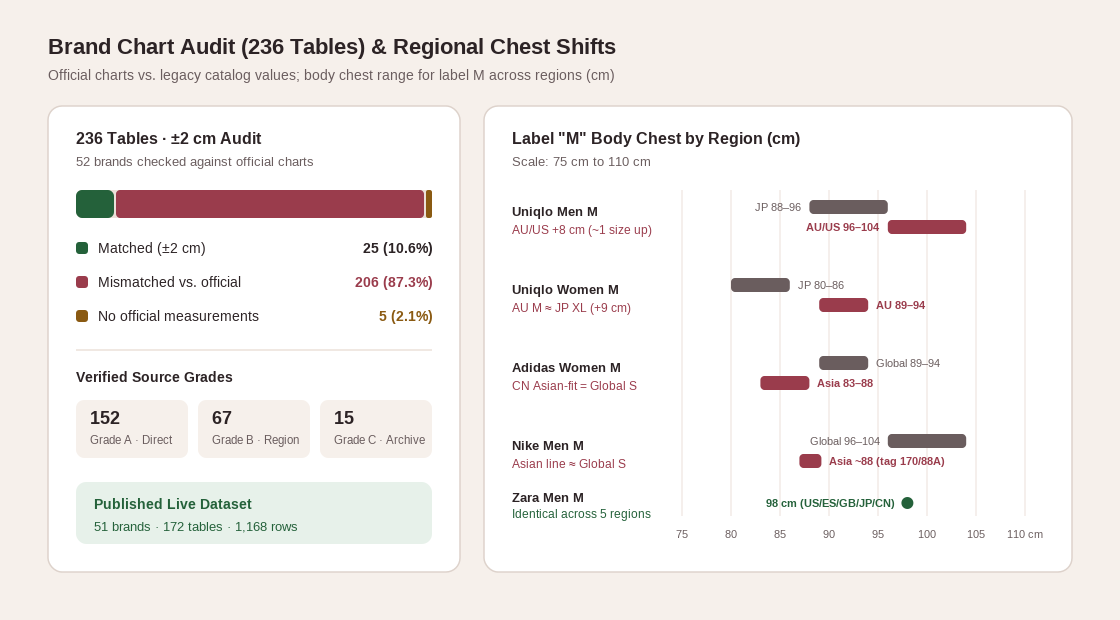
- Auditing 236 legacy brand tables across 52 brands within a ±2 cm tolerance showed only 25 matched (10.6%), 206 mismatched (87.3%), and 5 had no official measurements.
- Rebuilding from verified official body charts yielded 51 brands, 172 tables, and 1,168 rows with recorded Grade A/B/C sources and dates.
- Across 8 major brands, Uniqlo Men M shifts +8 cm from JP/CN/SG (88–96 cm chest) to AU/US (96–104 cm), while Zara serves an identical chest spec (98 cm) across US, ES, GB, JP, and CN.
- Switching reference-brand matching to official body range midpoints + category ease lifted recommendation coverage from 67.1% to 79.6% across a 4,446-request test grid.
When a shopper tells your storefront widget "I wear Uniqlo M", that single letter only predicts their body dimensions if you know which country's Uniqlo chart they bought from and whether your underlying table actually came from the brand.
When we audited the legacy reference dataset inside Shadow Size—236 size tables spanning 52 apparel brands—the gap between assumed numbers and published official brand charts was large enough to shift recommendations by one to four full sizes.
What the 236-table audit revealed
We checked every table row by row against official brand websites (Grade A: direct official storefront/size-guide fetch, 152 tables; Grade B: another country's official brand site, 67 tables; Grade C: archived official brand page, 15 tables; excluding 2 tables with no verifiable source) within a ±2 cm tolerance:
| Audit outcome | Tables | Share | Key finding |
|---|---|---|---|
| Matched official chart (±2 cm) | 25 | 10.6% | Mostly verified on primary chest or bust rows |
| Mismatched vs. official chart | 206 | 87.3% | Underestimated plus sizes, label off-by-one shifts, or garment specs mixed into body rows |
| No official measurements | 5 | 2.1% | Brands publishing only cross-label conversions (Diesel men's denim/shirts, Primark womenswear) |
After removing brands without official body measurements, out-of-scope loungewear/swimwear tables, and incomplete rows, our normalized production dataset stands at 51 brands, 172 tables, and 1,168 rows, all sourced to official body charts with recorded fetch dates.
Four systematic failure patterns accounted for most of the 206 mismatches:
- Plus-size underestimation (5 to 15 cm short): Legacy tables repeatedly compressed L and above well below brand specs. Mango men's chest ran 10–18 cm smaller than official figures, and specialty extended sizing drifted by up to 52 cm.
- Label off-by-one mapping errors: Measurements were right, but attached to the wrong tag—such as mapping H&M women's EUR 32 to XS instead of XXS, or Gap women's numeric 0/2 to S instead of XS.
- Mixing garment specs with body charts: Official brand size guides almost always publish body measurements (who the garment is drafted for), yet several legacy outerwear tables held garment measurements, causing downstream ease math to double-count room.
- No official body specs for bottoms: Several regional tables publish waist only or purely label conversions. For example, Uniqlo's published men's trouser body chart omits hip circumferences, and Levi's China product pages share garment dimensions plus height/weight tables rather than a universal body chart.
Same brand, different body: 8-brand regional study
Next, we fetched live size guides for eight global brands across the US, UK/EU, Japan, China, Singapore, Australia, and Indonesia to answer a practical question for cross-border Shopify merchants: does "Size M" actually change by country?
The answer splits into two distinct brand architectures: true regional shift (same alpha letter, different body block) versus global single chart (identical body dimensions, localized neck/GB tags).
| Brand | Architecture | Concrete regional discrepancy in official charts |
|---|---|---|
| Uniqlo | Regional shift | Men M chest: 88–96 cm in JP/CN/SG vs. 96–104 cm in AU/US (+8 cm, ~1 full size). Women M bust: 80–86 cm (JP 9-go) vs. 89–94 cm in AU (+9 cm; AU XS 79–84 cm equals JP M). |
| Adidas | Global chart + CN Asian-fit | US/GB/DE global body charts match (Men M 93–100 cm, Women M 89–94 cm). Adidas CN Asian-fit Women M is 83–88 cm—equal to Global S (−4 to −9 cm across S–XL). Since 2024, Adidas CN dropped A/J markings on physical hangtags. |
| Nike | Global main chart + Asian-sizing product line | GB, CN, and JP share an identical main chart (Men M 96–104 cm). Separately, nike.com.cn tags specific Asian-sizing SKUs where Men M uses CN 170/88A (~8 cm smaller than main M). |
| Zara | Single global chart | Direct checks across Zara's US, ES, GB, JP, and CN API endpoints returned identical Men M body chest (98 cm) and identical garment T-shirt specs. Note: CN tag 180/96A prints a chest number 2–6 cm smaller than Zara's own size guide. |
| Gap | US body chart relabeled in JP | Men chest (M 99–104 cm) and US W32 waist match between US and JP. However, gap.co.jp maps Women M to 13-go (while Uniqlo maps M to 9-go), making numeric Japanese tags non-transferable across brands. |
| Levi's | Global W/L standard | US and Indonesia body charts match (W32 waist 82.5–83.8 cm). Waist-inseam inch tags remain global, while CN uses per-SKU garment tables. |
| Lululemon | Global chart + Asia Fit line | Numeric sizes (2–12) match across US, EU, and CN within 0–2.5 cm; separate Asia Fit bottoms target narrower waists/hips on regional stores. |
| H&M | Unified EUR/US dual chart | Accessible official tables print EUR and US tags on the same body rows (Women EUR 38 = US 6, bust 86–90 cm, waist 70–74 cm). |
Why label conversion tables break recommendations
Merchants often ask for a simple dropdown that converts US M to EU M or JP L. The 8-brand study explains why flat label translation fails: regional tags do not shift uniformly even within the same country.
- Reading CN height/chest codes (170/92A vs 180/96A) literally as body specs misleads buyers: Zara's 180/100A (L) actually pairs with a 104 cm chart chest, whereas Uniqlo's 170/92A (M) sits right at the midpoint of 88–96 cm.
- Japanese numeric dress sizes shift by brand block: a Japanese shopper wearing Gap 13-go needs Size M in Gap, while in Uniqlo 9-go is Size M.
- Physical hangtags in some markets no longer print fit-line markers, meaning only a measurement check against the product's actual garment chart can prevent a one-size miss.
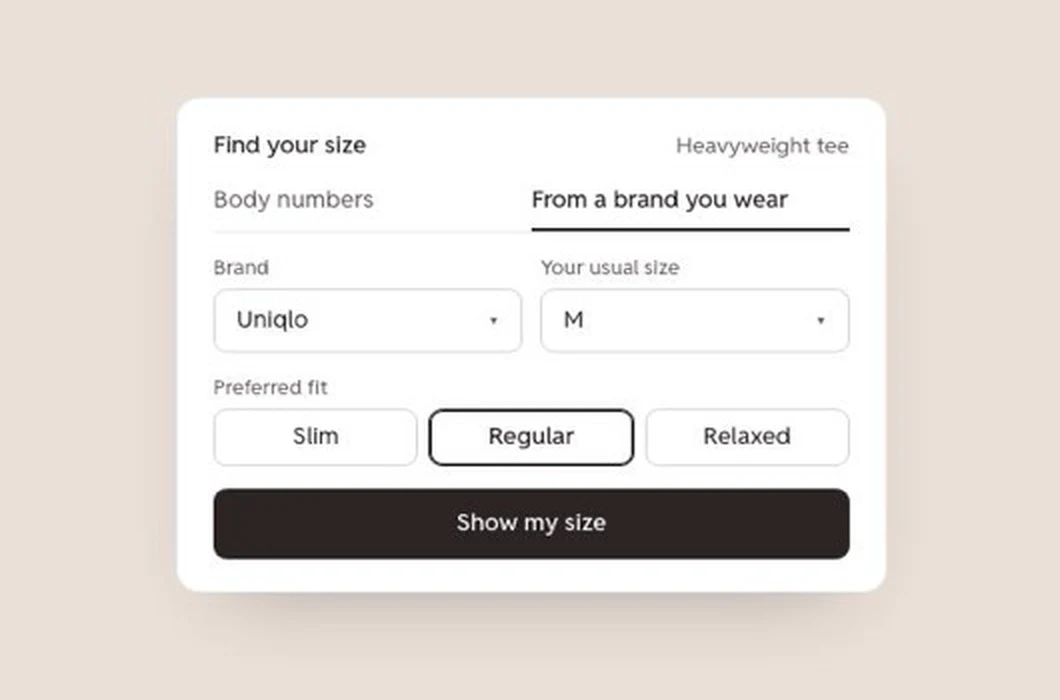
This is why Shadow Size never runs blind US/EU/JP tag translation. Instead, each reference brand maps (brand, gender, category, size, fitLine) to a curated body range midpoint in centimeters, and then evaluates ease directly against your product's garment chart—the exact same workflow described in our cross-border Asian to US/EU guide.
Fixing the math: 4,446-request benchmark before and after
Previously, reference-brand lookup subtracted a stored reference row from the merchant's garment chart (evaluateByDifference). Because 228 of the 236 official source tables turned out to be body charts rather than finished garments, comparing them directly against merchant garment measurements effectively recommended zero ease or negative ease.
For example, picking Uniqlo Men XL (official body chest 104–112 cm) on a regular-fit cotton tee previously matched Size S (100 cm garment chest—a painful −8 cm tight error). Routing official body range midpoints through our category ease rules switched the pick to Size XL (118 cm garment chest, +10 cm ease).
Across a deterministic 4,446-request grid (19 storefront brands × men/women × XS–XXL × 9 benchmark garment charts × Slim/Regular/Relaxed preferences):
| Metric | Legacy garment-diff path | Body midpoint + ease path | Impact |
|---|---|---|---|
| Requests returning a recommendation | 2,985 / 4,446 (67.1%) | 3,537 / 4,446 (79.6%) | +552 valid answers (+12.5 pts) |
| Newly enabled valid matches | — | 939 | Fixed missing brand aliases & sparse rows |
| Removed unsafe guesses | — | 387 | Stopped cross-gender guessing and hip-less bottom guesses |
| Direction on shared 2,598 requests | — | 2,005 sized up (+77.2%), 578 same, 15 down | Eliminated systematic zero/negative-ease undersizing |
Notice that 387 legacy requests were intentionally retired: we prefer declining or falling back to simple height/weight inputs rather than guessing a women's fit from a men's chart or recommending trousers without hip data.
Practical takeaway for Shopify merchants
- Record body vs. garment clearly: Never paste a body measurement chart into a garment measurement template. See our ease allowance engineering guide for category-by-category target gaps.
- Preserve regional context when selling cross-border: Specify whether your imported size block follows US/EU specs or Asian-fit specs, or keep measurements explicitly in cm/inches inside Shadow Size.
- Never promise magic label equivalence: Shoppers keep the garment when you show them chest +8 cm room rather than telling them "Asian L equals US M".
Try it on your own store. The Free plan includes 100 size suggestions a month.
Install on Shopify