 Shadow Size
Cotton Shrinkage by the Numbers: When Wash Shrinkage Shifts a Garment by a Full Size
In short
- Tumble drying shrinks cotton primarily through mechanical agitation and compression below ~20–30% moisture—dryer heat alone (38 °C vs. 66 °C vs. 94 °C) showed no independent effect in lab tests.
- Roughly 90% of relaxation shrinkage releases on the first wash-and-tumble cycle, with garment length consistently shrinking more than width.
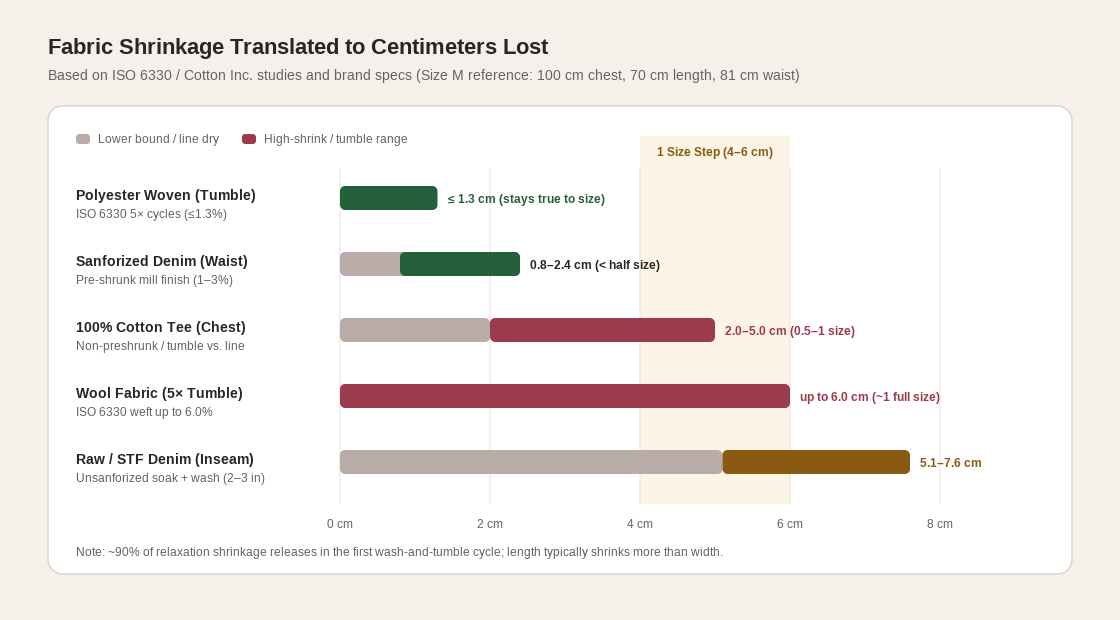
- On a Size M T-shirt (100 cm chest / 70 cm length), a 3–5% shift removes 3–5 cm of chest (half to one full 4–6 cm size grade), whereas polyester wovens stay ≤1.3% (≤1.3 cm) and sanforized denim shifts only 0.8–2.4 cm.
- Full size-up rules are only warranted for unsanforized / raw Shrink-to-Fit denim (2.5–5.1 cm waist, 5.1–7.6 cm inseam) and non-pre-shrunk 100% cotton or tumble-dried wool.
Shoppers frequently leave a five-word fit review that turns healthy conversion into avoidable returns: "Fitted on arrival, shrank after washing." On the other hand, telling every shopper to "size up for shrinkage" pushes customers wearing polyester blends or garment-dyed pre-shrunk tees into baggy exchanges.
To separate textile science from folklore, we reviewed ISO 6330 / AATCC 135/150 washing standards, Cotton Incorporated lab manuals, peer-reviewed knit and woven shrinkage studies, and published brand care specifications—then translated every percentage directly into centimeters on standard garments.
Why tumble drying shrinks clothes (and why heat is blamed unfairly)
Both Cotton Incorporated (ISP 1009) and Higgins et al. (Textile Research Journal, 2003) converge on the same mechanical finding: during weaving, knitting, and wet finishing, yarns sit under lengthwise tension. Washing lubricates fibers so trapped tension begins relaxing, while tumble agitation repeatedly drops wet fabric once moisture falls below roughly 20–30%, mechanically compacting loops and threads closer together.
Crucially, lab trials testing dryer temperatures of 38 °C, 66 °C, and 94 °C found no statistically meaningful difference from air temperature once dryness and tumble mechanics matched. In other words: switching from hot tumble to warm tumble changes little; switching from tumble dry to flat/line dry is what preserves length and chest width.
Moreover, roughly 90% of relaxation shrinkage occurs in the very first home wash-and-tumble cycle, though woven cotton and wool continue creeping slightly past five wash cycles.
Lab shrinkage translated into real centimeters
Percentage tables mean little to a shopper staring at S / M / L buttons. Below, we map verified lab and brand figures onto two baseline garments: a Size M T-shirt (100 cm chest / 70 cm length, typical 4–6 cm chest grade) and Size 32 jeans (81 cm waist / inseam):
| Fabric / Finish | Test or brand source | Expected shrinkage (%) | Loss in cm (M tee / 32 jeans) | Real sizing impact |
|---|---|---|---|---|
| Polyester woven (5× tumble) | ISO 6330 (*Fibres & Textiles*, 2020) | Warp ≤1.3% · Weft ≤0.9% | ≤1.3 cm chest / ≤0.9 cm length | Stays true to size; never advise sizing up |
| Sanforized denim | Mill compressive pre-shrink standard | 1–3% | 0.8–2.4 cm waist & inseam | Less than half a waist size; snug belt loosens slightly with wear |
| Pre-shrunk garment-dyed tee | Brand spec (e.g., Comfort Colors 1717) | Minimal residual after dye wash | ~0–2 cm | Safe to recommend true to chart |
| Standard 100% cotton woven | ISO 6330 (drip line vs. 5× tumble) | Warp ~2% → 4–7.5% · Weft 0.7–3.5% | 2.0–5.0 cm length (at 3–5%) | Noticeable length loss if tumble-dried repeatedly |
| Unfinished cotton jersey knit | Mikučionienė & Laureckienė (2009) | Hang 14–15% L vs. Tumble 22% L | Illustrates upper bound prior to mill finishing | Shows why cheap uncompacted knits shrink +6–8 pts more in dryers |
| Wool woven (5× tumble) | ISO 6330 (*Fibres & Textiles*, 2020) | Warp 1.5–4.5% · Weft 1.5–6.0% | Up to 6.0 cm weft | Can drop ~1 full size if accidentally tumbled |
| Raw / Shrink-to-Fit denim | Brand care specs (Levi's 501 STF) | Waist 1–2 in · Inseam 2–3 in | 2.5–5.1 cm waist · 5.1–7.6 cm inseam | Mandatory 1–2 size adjustment if soaked/washed; waistband stretches back faster than inseam |
Notice the consistent directional rule: garment length shrinks more than garment chest or width because industrial knitting and weaving pull yarns hardest along the warp/wale (vertical) direction. On a 70 cm cotton torso, losing 5% equals 3.5 cm in length—enough to turn a regular hem into a belly-baring crop after one dryer cycle.
What Shopify clothing stores should actually tell shoppers
Honesty on the product page works better than blanket disclaimers—and prevents both under-buying and over-buying:
- Disclose whether your chart reflects pre-wash or post-wash dimensions: Most cut-and-sew mills pattern pre-shrunk garments slightly larger in raw cutting so the pre-wash finished spec matches the chart within ±1 cm. Say "Measurements reflect new garment prior to washing" so buyers understand what arrives in the mailer.
- Reserve "Size up" guidance for three fabrics only:
- Unsanforized / raw Shrink-to-Fit denim: Print exact cold-soak vs. machine-wash allowances (+1 in waist for 27–36, +2 in waist for 38–48, +2–3 in inseam—matching Levi's published guide).
- Non-pre-shrunk 100% cotton jersey & heavy fleece: When a shopper selects Slim fit or sits near the bottom of an ease band, flag length shrinkage and recommend cold wash + flat/line dry.
- Pure wool knitwear or woven outerwear: Explicitly warn against tumble drying, where weft shrinkage reaches up to 6% (~1 full size).
- Never penalize stable fabrics: Do not tell shoppers buying polyester athletic wear, cotton/elastane ribbed blends, or garment-dyed pre-shrunk cotton to size up—they will receive oversized items and return them anyway.
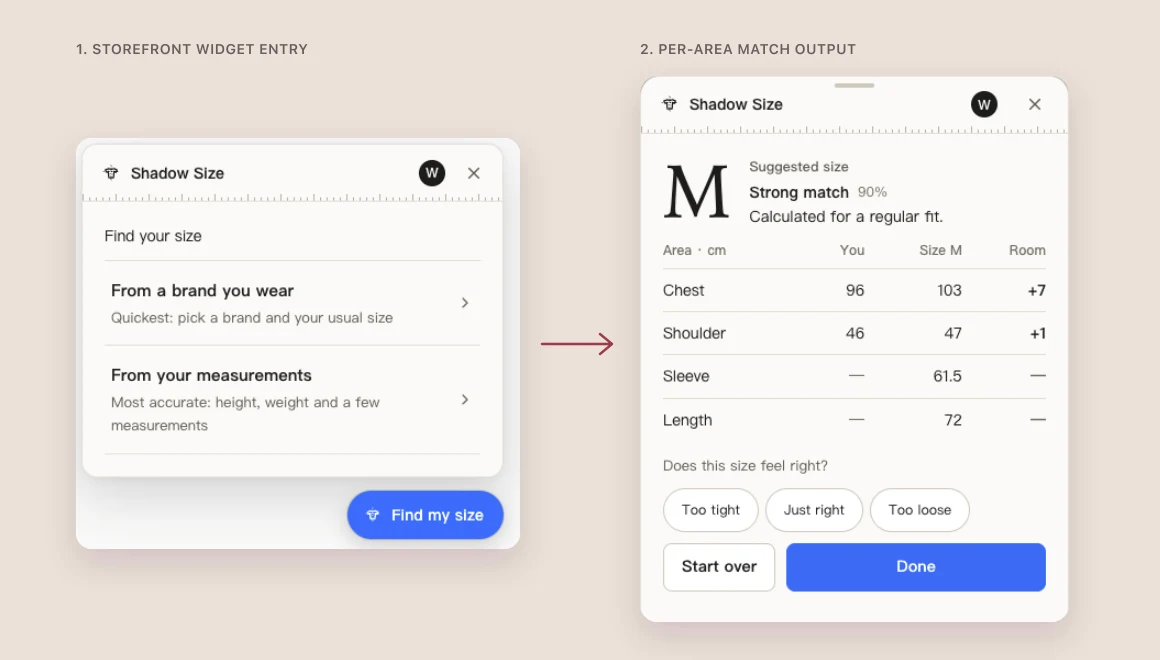
With Shadow Size, per-area fit notes already tell borderline shoppers *how tight or relaxed each measurement is before washing*, making borderline choices transparent on both mobile and desktop product pages.
Try it on your own store. The Free plan includes 100 size suggestions a month.
Install on Shopify